Processing Pipeline Details
ProMaya utilizes a robust Nextflow pipeline to scale protein-protein interaction predictions from single pairs to massive, multi-protein screening campaigns.
Pipeline Architecture
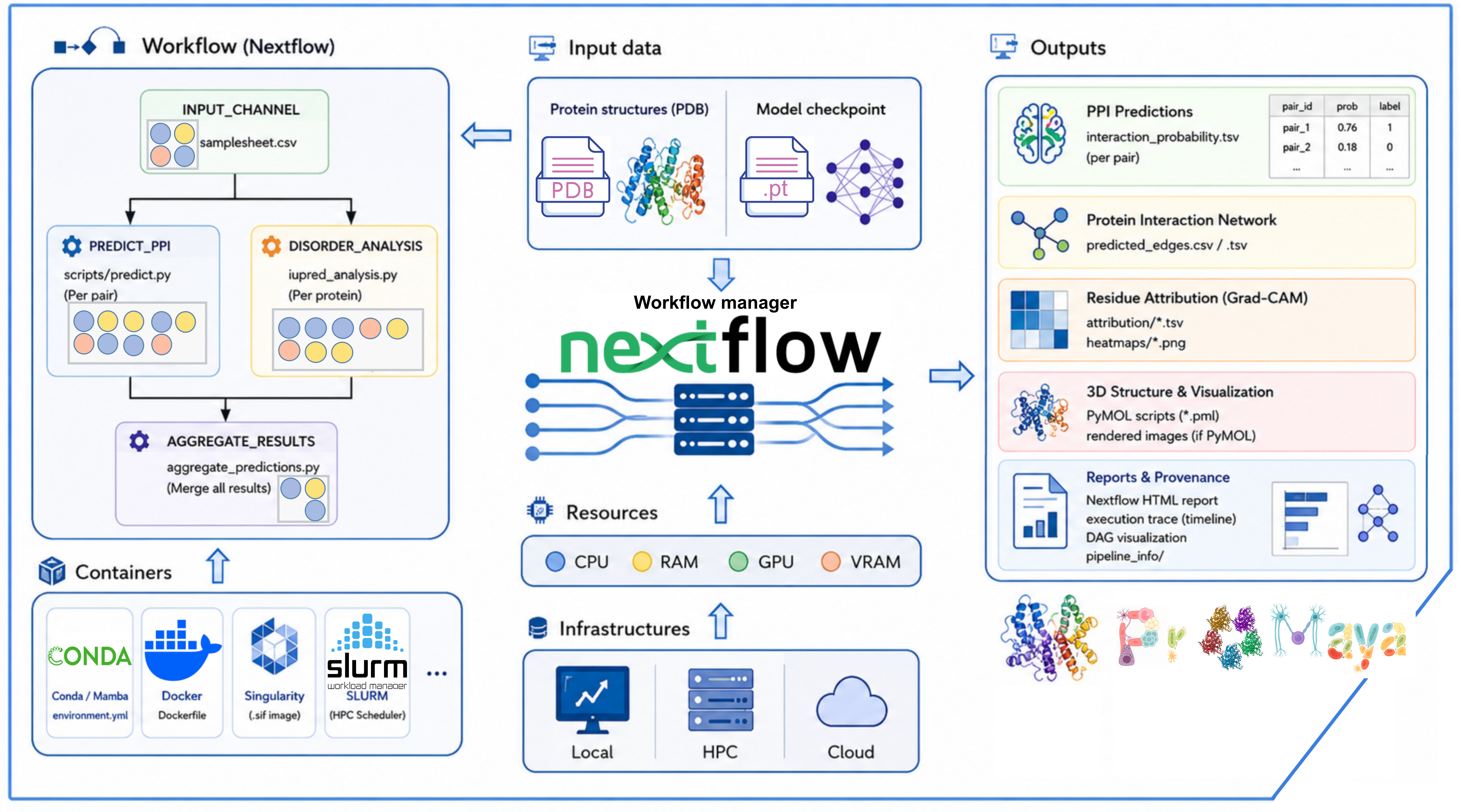
The workflow parses input PDB structures, manages deep learning inference through the ProMaya architecture, and orchestrates supplementary structural biology analysis.
Workflow Execution Steps
Depending on the configuration flags provided, the pipeline executes the following high-level operations:
-
Input Parsing (
splitCsv): The pipeline begins by reading the user-providedsamplesheet.csv, splitting the dataset, and generating an independent parallel execution channel for every protein pair. -
Core Inference (
PREDICT_PPI): For each pair, Nextflow provisions a containerized environment (or Conda environment) and executes the core ProMaya architecture. This single module encapsulates the full structural multi-modal pipeline: - Feature Extraction: Generates atomic graphs, residue graphs, surface point clouds, and extracts ProtTrans-650M language model embeddings.
- Multimodal Alignment: Fuses the multi-scale representations through a 4-stage bidirectional cross-attention mechanism.
- HGT Encoder: Passes the fused graph through 4 Heterogeneous Graph Transformer layers to capture complex topological dependencies.
- Cross-Protein Interaction: Computes interaction probabilities using multi-scale cross-protein attention.
-
Classification: Outputs final interaction scores using a hybrid Neural-XGBoost layer.
-
Interpretability Extraction (Optional): If
--gradcam trueis active, thePREDICT_PPIstep computes backward passes to extract multi-scale attributions (Atom, Residue, Surface), outputting detailed TSVs and rendering 3D attribution hotspots (via PyMOL). -
Intrinsic Disorder Scan (
DISORDER_ANALYSIS): (Optional: triggered by--run_disorder true). Nextflow intelligently extracts unique PDB files from the samplesheet and runs an IUPred2A/MetaPredict structural disorder scan exactly once per protein, saving compute resources. -
Data Aggregation (
AGGREGATE_RESULTS): Once all parallelPREDICT_PPItasks complete, the pipeline collects every individualprobability.tsvand merges them into a single, sortedmaster_predictions.tsvfile, serving as the primary screening output.
Deterministic Output Management
To guarantee reproducibility and safe caching (-resume), ProMaya manages the raw output of the prediction scripts. While the internal python script generates timestamped output directories (to prevent collisions during manual execution), the Nextflow wrapper deliberately flattens these into stable, pair-specific directories (e.g., results/predictions/<pair_id>).